
Important Questions to Ask When Choosing a Nursing Home
Finding the right nursing home for your loved one is one of the most important decisions your family can make. Asking thoughtful, thorough questions during your nursing home search can help you determine the best fit, so your family has the peace of mind that your loved one is getting the care and attention they deserve. Below are some critical questions to ask facilities in your nursing home search.
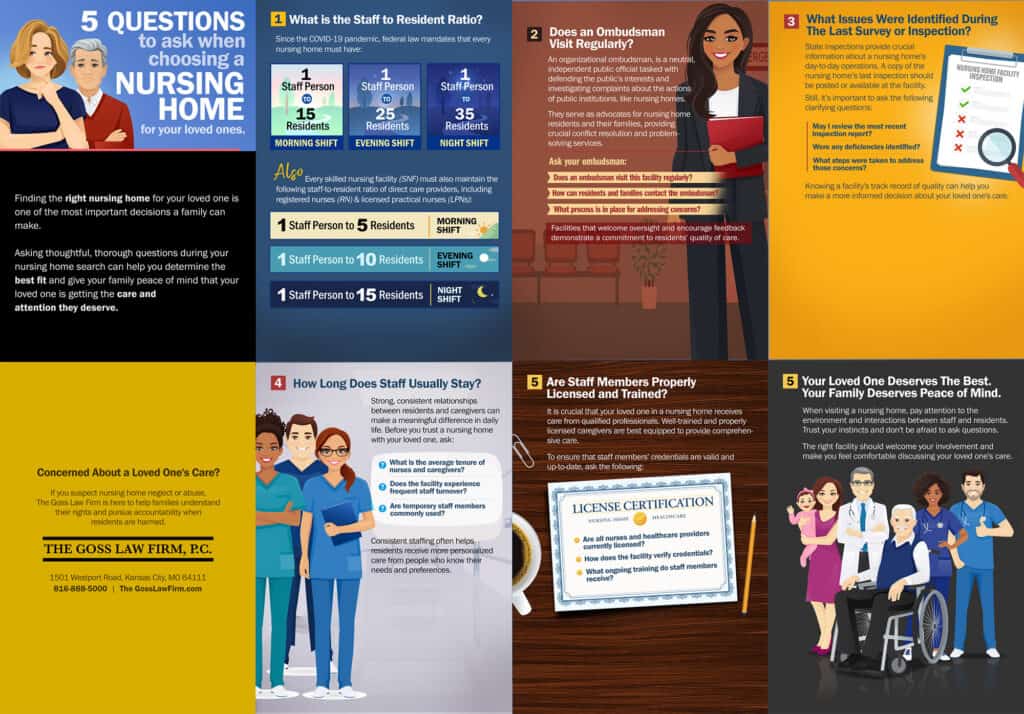
Download the 5 Questions to Ask When Choosing a Nursing Home Infographic.
What is the staff-to-resident ratio?
Since the COVID-19 pandemic, federal law mandates that every nursing home must have:
- 1 staff person to 15 residents during the morning shift
- 1 staff person to 25 residents during the evening shift
- 1 staff person for 35 residents during the night shift
Skilled nursing facilities (SNFs), which provide more clinical, short-term care from direct care providers, registered nurses (RNs), and licensed practical nurses (LPNs), have a different set of standards:
- 1 staff person to 5 residents during the morning shift
- 1 staff person to 10 residents during the evening shift
- 1 staff person to 15 residents during the night shift
If the nursing home or skilled nursing facility does not disclose the staff-to-resident ratio or meet the required criteria, it’s most likely not a good fit for your loved one.
Does an ombudsman visit regularly?
It’s important to understand the role of an ombudsman in your loved one’s care. An organizational ombudsman is a neutral, independent public official tasked with defending the public’s interests and investigating complaints about the acts of public institutions, including nursing homes.
They serve as advocates for nursing home residents and their families, providing crucial conflict resolution and problem-solving services. In addition, ask for an ombudsman:
- Does an ombudsman visit regularly?
- How can residents and families contact the ombudsman?
- What process is in place for addressing concerns?
Facilities that welcome oversight and encourage feedback demonstrate a commitment to residents’ quality of care.
What issues were identified during the last survey or inspection?
State inspections provide vital information about a nursing home’s day-to-day operations. A copy of the nursing home’s last inspection should be posted or available at the facility.
Still, it’s important to ask the following clarifying questions:
- May I review the most recent inspection report?
- Were any deficiencies identified?
- What steps were taken to address those concerns?
Knowing a facility’s track record of quality can help you make a more informed decision about your loved one’s care.
How long does staff usually stay?
Strong, consistent relationships between residents and caregivers can make a meaningful difference in daily life. Before you trust a nursing home with your loved one, ask:
- What is the average tenure of nurses and caregivers?
- Does the facility experience frequent staff turnover?
- Are temporary staff members commonly used?
Consistent staffing often helps residents receive more personalized care from people who know their needs and preferences.
Are staff members properly licensed and trained?
Your loved one in a nursing home must receive care from qualified professionals. Well-trained and properly licensed caregivers are best equipped to provide comprehensive care. To ensure that staff members’ credentials are valid and up-to-date, ask the following:
- Are all nurses and healthcare providers currently licensed?
- How does the facility verify credentials?
- What ongoing training do staff members receive?
Concerned About a Loved One’s Care?
When visiting a nursing home, remember to pay attention to the environment and interactions between staff and residents. Trust your instincts and don’t be afraid to ask questions; the right home should welcome your involvement and make you feel comfortable discussing your loved one’s care.
If you suspect nursing home neglect or abuse, The Goss Law Firm is here to help families understand their rights and pursue accountability when residents are harmed.
Contact us today by submitting an online form or calling our office at (816) 888-5000 for a free legal consultation.